

Slow escalations are one of the biggest reasons IT support team miss service-level agreements (SLAs). When Tier 1 agents escalate tickets without complete diagnostics, Tier 2 engineers spend valuable time gathering information instead of resolving issues. It results in longer resolution times, frustrated users, and higher support costs.
If you’re responsible for support operations, especially across multiple locations or time zones, a well-structured Tier 1-to-Tier 2 escalation workflow can improve resolution speed, reduce ticket backlogs, and increase support team efficiency.
This guide walks you through exactly how to build one.
Understanding Tier 1 and Tier 2 Support
It is important to understand the difference between Tier 1 and Tier 2 support, as both are important for effective IT support in any organization.
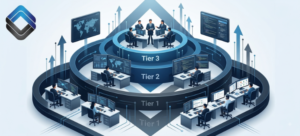
Tier 1 is the first point of contact for the user. Tier 1 teams will answer calls for common issues (e.g., password resets, basic troubleshooting, account questions, and general questions). Tier 1 support agents follow written procedures and articles in order to resolve routine issues quickly and efficiently.
When the Tier 1 agent cannot resolve a user’s issue, they will escalate it to Tier 2 support.
Tier 2 support agents, or technicians, have deeper technical knowledge of the organization’s systems, applications, and infrastructure. They are better qualified to perform a deeper investigation into the root cause analysis, run through diagnostics, and provide a comprehensive resolution to the user’s issue.
By having this model of structured support, businesses can maximize the number of resources used, minimize the time to resolve issues, maximize cost-saving opportunities, and improve overall end-user satisfaction. The use of this structured model for IT support will allow the organization to provide different levels of support for different levels of problems, and provide continued seamless support to their users.
Tier 1: First Contact and Documentation
Tier 1 is the front-line team where issues are documented first. Therefore, a well-structured first interaction can prevent needless back-and-forth with the user. The user would receive a definitive response and resolution, with the right communication at the right time, without having to go through multiple unnecessary interactions.
Typical Tier 1 work involves access issues, software errors, basic connectivity problems, and system configuration checks, to name a few. All of them are recurring problems that need constant prioritization.
Beyond resolution, Tier 1 also prepares tickets and preliminary documentation to take the issue forward, if the situation demands it.
Tier 2: Deeper Expertise, Context-Dependent
Tier 2 engineers can resolve complex incidents faster. They handle issues that require advanced troubleshooting, elevated access, or cross-system investigation.
However, missing details force engineers to recreate diagnostic steps, increasing resolution times. They need logs, previous steps (if any), and any other available details. Without those details, a lot of time is wasted or lost reconstructing the problem.
The Purpose of Tiered Support Structures
The main purpose of the tiered support structure is to maintain the balance between Tier 1 and Tier 2 by pushing only the right tickets to Tier 2. When that balance breaks:
- Tier 2 gets flooded with tickets they shouldn’t be handling
- Resolution times increase across the board
With this, every unnecessary escalation adds agent time, management overhead, and SLA risk.
Escalation vs. Ticket Routing: A Distinction that Decides the Workflow
Ticket routing is mostly automatic. It happens during ticket creation and routes the issue to the appropriate starting point based on category, keyword, or requester type.
Escalation, on the other hand, is a deliberate handoff. It should only happen after Tier 1 has documented the issue, attempted resolution within their scope, and confirmed the problem is beyond their authority or capability.
Conflating escalation and ticket routing leads to misrouted tickets that appear with no context, no diagnostic steps, and no ownership clarity.
What Actually Triggers a Legitimate Escalation
In enterprise IT environments, escalation should not be a judgment call made by different agents. Instead, defined triggers bring consistency in escalation. Here are some common legitimate escalation triggers that IT environments face:
- Time exceeded: when the ticket has been open beyond the SLA threshold without resolution.
- Access restrictions: Permissions or access that Tier 1 does not hold.
- Complexity limit reached: When cross-system dependencies Tier 1 cannot handle.
- Integration failure: Two systems have stopped communicating, and the fix requires backend access.
- Security and compliance concern: When there is potential data exposure, unauthorized access, or regulatory risk.
Accurately mapping these triggers reduces uncertainty in escalation.
A Step-by-Step Framework for Building Tier 1 to Tier 2 Escalation Workflows
A defined framework is key to any workflow or process. Accordingly, we outline the following 7 steps for building a competent Tier 1-to-Tier 2 escalation workflow.
Step 1: Categorize and Classify Incoming Requests
Without accurate classification of all incoming requests, everything downstream, i.e., Tier 2 teams, struggles due to a lack of information or context.
Understanding this IT ticket escalation process improves response times, reduces costs, and enhances customer satisfaction for businesses.
Step 2: Define Escalation Triggers
Defining triggers prevents escalation from becoming guesswork. For that, the following categorization is implemented:
- Time-based triggers ensure tickets do not linger beyond acceptable limits
- Complexity-based triggers prevent teams from getting stuck
- Impact-based triggers prioritize business-critical issues
- Security triggers fast-track sensitive problems
Step 3: Establish Escalation Paths and Ownership
Every escalation path must be clear and have defined responsibilities at each stage. This means there should be no confusion about the protocol for determining which team is responsible for handling an issue and to what extent before escalating.
Step 4: Standardize Communication and Handoff Procedures
A smooth Tier 1-to-Tier 2 handover depends on clear communication and complete information. Status updates alone are not enough; the context must make sense to the next team.
A weak handoff might look like this: “User can’t log in. Escalating to Tier 2.” There are no details. As a result, the Tier 2 team now has to start from scratch.
A strong handoff involves:
- What’s wrong
- What was already tried
- Error messages or screenshots (not paraphrased)
- Who is affected (one person, one team, or the whole office)
- How urgent it is (has work stopped or slowed down)
When every escalation includes these five things, Tier 2 can start solving the problem in minutes. That means faster resolution, fewer back-and-forth calls, and a better user experience.
Step 5: Create Documentation Requirements
Documentation is a time-saver and should be mandated. Done right, it reduces rework and accelerates resolution. But if it’s not written down, Tier 2 has to find out the issue from scratch. That costs time, and time is money.
Instead, having a short checklist to go through before any ticket can move from Tier 1 to Tier 2 can help.
Every documented ticket is also a reusable answer: the next time the same problem shows up, it could be resolved faster.
Step 6: Automate What’s Repeatable
Automating the escalation path within the ticketing system removes manual delays and ensures consistent policy enforcement. There are tools that can help organizations replace human-dependent handoffs with instant and reliable workflows.
However, remember that automation is for basic and repetitive steps, not for advanced issues.
| What role does automation play in escalation workflows?
Automation ensures timely escalation through SLA rules and predefined triggers. It removes delays and keeps processes consistent. This is while still allowing teams to focus on judgment-based troubleshooting. |
Step 7: Monitor and Continuously Refine the Workflow
Regular ticket reviews keep workflows effective. Also, it is important to analyze key metrics like response times to identify hidden bottlenecks. This data, alongside direct agent feedback, helps with unhindered refinement.
| Building up capability is crucial to tiers. Training Tier 1 teams properly is important because when they understand systems better, they tend to resolve issues without escalation.
Additionally, troubleshooting playbooks help. They create consistency in handling repeating problems. Also, a force multiplier that’s often underestimated is a well-maintained knowledge base. It gives Tier 1 more confidence and reduces its dependence on Tier 2. |
The Role of Outsourced Help Desk Providers in Escalation Management
Escalation workflows break down often outside business hours. If your Tier 2 internal team is not available at 2 AM and a critical system goes down, the workflow will be affected. This is where you require an organization that runs IT support across time zones.
Experienced help desk service providers like 31West bring tried-and-tested escalation frameworks. This way, we help IT managers and CTOs maintain an on-demand escalation workflow.
What Effective Escalation Actually Looks Like
When Tier 1 and Tier 2 operate from the same framework, escalation stops being a pain point and becomes a system that works.
With shared triggers, defined handoff requirements, and documented paths, users experience consistency regardless of ticket complexity. With 31West’s IT support escalation process, the goal is not to eliminate escalation; it’s to make every escalation deliberate, complete, and fast.
31West provides outsourced IT help desk services with 24/7 coverage, structured escalation workflows, and specialized Tier 2 expertise. Learn more about our help desk services.