
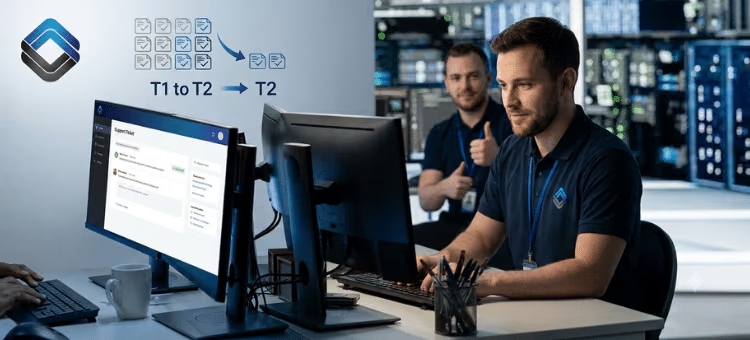


Every service desk leader has stared at an escalation report and felt that everything was going downhill. This is what the situation could look like: The Tier 2 queue is backed up again because Tier 1 agents are passing along tickets they could have closed themselves.
Worse, somewhere in the middle of it all, the end user is still waiting for an answer.
At 31West, we have managed help desks across healthcare, finance, hospitality, and MSP environments for more than two decades. We have found that most escalations aren’t caused by overly complicated problems; they’re caused by gaps.
Such gaps may be in knowledge, training, or how tickets get routed in the first place. If you manage to address and fill the gaps, the escalation rate takes care of itself.
Effective service desk management depends on getting the Tier 1 to Tier 2 support handoff right. That single decision shapes the cost and resolution speed, significantly affecting how the end user feels about the overall interaction.
In this piece, we’re breaking down how to bring down escalation volume, based on what we’ve seen succeed (and fail) in real support operations.
We’re not talking about a one-off audit either: getting the escalation rate down requires treating the Tier 1 to Tier 2 handoff as an ongoing part of service desk management.
Why Escalations Pile Up in the First Place
Before planning for a resolution, it helps to understand why tickets end up escalating unnecessarily.
In our experience, four causes show up again and again:
- Knowledge that’s outdated, where Tier 1 agents can only resolve what they can locate. A knowledge base that’s remained untouched for a long time will compel Tier 1 agents to escalate.
They would rather escalate than guess and make a mistake.
- Vague or missing escalation criteria: when the Tier 1 agent doesn’t have any documented threshold for what qualifies as a Tier 2 issue.
Here, Tier 1 agents make the call on gut instinct, where some escalate too early. Then there are others who “sit” on a ticket too long before finally escalating, frustrating the user/customer.
- Inadequate training that stops after week one is a red flag for any support process. A lot of organizations believe all they need to do is onboard Tier 1 agents, hand them a script, and the rest will take care of itself.
It’s never that simple: real competence actually comes from ongoing coaching tied to relevant ticket categories.
- Agents escalate defensively when they’re worried about breaching an SLA. Nobody wants to be the one who sat on a ticket too long: when the clock is running short, escalating feels like the safer move.
That instinct is understandable, but it quietly inflates the Tier 2 queue with tickets that never needed to leave Tier 1 in the first place.
In fact, according to Glen Hoffman’s analysis for HDI’s Support World, high escalation rates serve as a diagnostic signal pointing to gaps in analyst training, knowledge access, or ticket routing. If you pay attention, you will be able to identify that something is wrong long before your customer satisfaction scores tell you so.
Six Proven Ways to Bring Escalation Rates Down
You don’t need a bigger team or budget to improve Tier 1 help desk efficiency toward fewer escalations. You require discipline around knowledge, training, and process, and the ability to apply it consistently.
Here’s the order we’d tackle them in:
Method 1: Build a Knowledge Base Tier 1 Actually Uses
A knowledge base that nobody utilizes is pointless, apart from providing leadership with a false sense of comfort. In the meantime, agents keep escalating anyway.
The solution isn’t to craft more articles or simply to add a repository of information. The real solution is to update the knowledge base with accurate information and do so regularly.
Focus on the ticket categories driving the highest volume. Review and refresh the available information on a set schedule (ideally every few months or more frequently) so agents trust what they find.
Also, don’t forget to embed the knowledge directly into the ticketing workflow; a separate portal that nobody remembers to check will do no good.
Let’s consider this:
We once worked with a mid-sized healthcare client whose Tier 1 team was escalating nearly every ticket in their EHR system. The issues weren’t complex, but since nobody had ever shown agents where the relevant diagnostic logs lived, guessing felt riskier.
Conversely, a focused update to a specific section of the knowledge base reduces those escalations within weeks.
Method 2: Write Escalation Criteria Down, Then Enforce Them
You cannot have Tier 1 agents with different ideas about when a ticket should be escalated. That inconsistency inevitably results in unnecessary Tier 2 volume.
A documented escalation policy spells out the rules of escalation or triggers:
- The resolution requires system-level access that Tier 1 doesn’t have
- The agent has already tried standard troubleshooting steps without success
- The ticket is at risk of breaching its SLA
- The same issue has recurred multiple times in a short window
With a clear list, Tier 1 to Tier 2 escalation becomes an informed decision.
Method 3: Treat Tier 1 Training as an Ongoing Program, Not a One-Time Event
Build a multi-day onboarding track for new agents, break down the knowledge base into small, digestible modules, and have Tier 1 trainees shadow live ticket resolution and draft responses that tenured agents review before anything goes out. That review loop should be run continuously. Additionally, ensure your Tier 1 agents are cross-trained across the systems and applications your users touch most.
Method 4: Fix Routing Before You Blame the Agent
Sometimes the problem is not at the Tier 1 agent level; it’s in the ticket categorization.
Misrouted tickets land with a team that has to reroute them again. This adds a delay before the actual troubleshooting even starts.
This can play out with password reset tickets tagged under some category like “account access” routed to a queue meant for account provisioning. Tier 1 agents kept escalating because the ticket landed with the wrong specialists from the start.
It was never a question of whether the resolution was too hard or complicated.
Structured categories, consistent tagging, and periodic reviews of routing patterns are necessary to detect and resolve this systemic problem.
As a practice, you can pull a sample of “escalated” tickets each month and ask: does this issue belong in Tier 2? Or did it get pushed up by Tier 1 because the categorization sent it to the wrong queue from the start?
Method 5: Measure Escalation Rate as a Diagnostic, Not Just a Number on a Dashboard
Help desks track escalation rates, but few use them to diagnose anything. The mistake most service providers make is treating escalation as just another line item alongside ticket volume and average handle time.
The escalation rate is more useful when paired with First Contact Resolution (FCR) and Mean Time to Resolve (MTTR). This is because they collectively tell you where the process is breaking down.
Method 6: Create a Quick-Consult Option Before Full Escalation
Sometimes, a Tier 1 agent needs someone with more experience to glance at what they’re seeing. They need confirmation that they’re on the right track or to be pushed toward it.
Setting up a quick-consult option where a senior Tier 1 agent or a Tier 2 specialist can weigh in on a ticket without it formally changing hands will assuredly produce good results.
The ticket stays with Tier 1, and Tier 2 never has to open a new case.
This can include a shared chat channel or whatever works; the mechanism matters less than making it predictable. Agents reach for it instead of going for a full escalation.
However, if a consult turns into a fifteen-minute back-and-forth, the Tier 1 agent has essentially escalated the ticket anyway (without the paperwork). To avoid this, there must be a time limit.
If the issue isn’t resolved in that window, let it escalate properly.
This works particularly well at support desks where Tier 1 agents cover a lot of ticket categories without going deep.
If you pair it with a knowledge base that agents can update on the spot, the lessons from each quick consult stop getting lost with time.
Mistakes That Undermine Escalation Reduction Efforts
Even with the right methods in place, we’ve observed well-intentioned efforts stall.
- The first is penalizing agents for escalating: if a manager treats every escalation as a personal failure, Tier 1 agents start sitting on tickets they should have handed off. That protects the number on a dashboard but makes the actual user experience worse. Escalation is necessary when a Tier 1 agent doesn’t have the knowledge to resolve an issue.
- The second is rolling out a refreshed knowledge base without training Tier 1 on how to use it. Documentation only helps if people know it exists and trust it. Environments with genuinely solid internal knowledge bases that nobody consults are useless. This is usually a result of past versions being unreliable for too long for agents to put their trust in them.
- Also, you cannot treat Tier 2 as an afterthought in escalation reduction, as Tier 2 agents usually know which ticket types get escalated needlessly. Leaving them out of the planning process means losing that insight.
- Measuring escalation rate in isolation without looking at reopened tickets alongside it doesn’t tell the whole story. A ticket closed prematurely by Tier 1 just to avoid an escalation damages the user experience.
Bringing It Together
Reducing escalations from Tier 1 to Tier 2 isn’t achieved by adding more people to Tier 2. Service desk management stops feeling like a constant game of catch-up when Tier 1 teams have what they need to close the loop on their own. This includes current knowledge, clear criteria, real training, and routing that works.
None of this happens overnight, and you must be skeptical of anyone who says otherwise.
Having done this across healthcare, finance, hospitality, and MSP environments, we can say that the service desks with the lowest escalation rates are the ones where Tier 1 agents are actually set up to succeed.
If your Tier 1 to Tier 2 handoff feels messier than it should, we’re happy to take a look at what’s happening.
Reach out to our team for a custom quote, and we’ll introduce you to a properly structured, low-escalation support model.