


Your business might offer excellent products, but what matters eventually is how your customers feel when doing business with you. That’s why customer service is at the heart of any business.
It’s so important that 79% of customers will happily switch to your competitors if you fail to provide a meaningful customer experience. The reason alone is enough for companies to consider outside-business-hours-support.
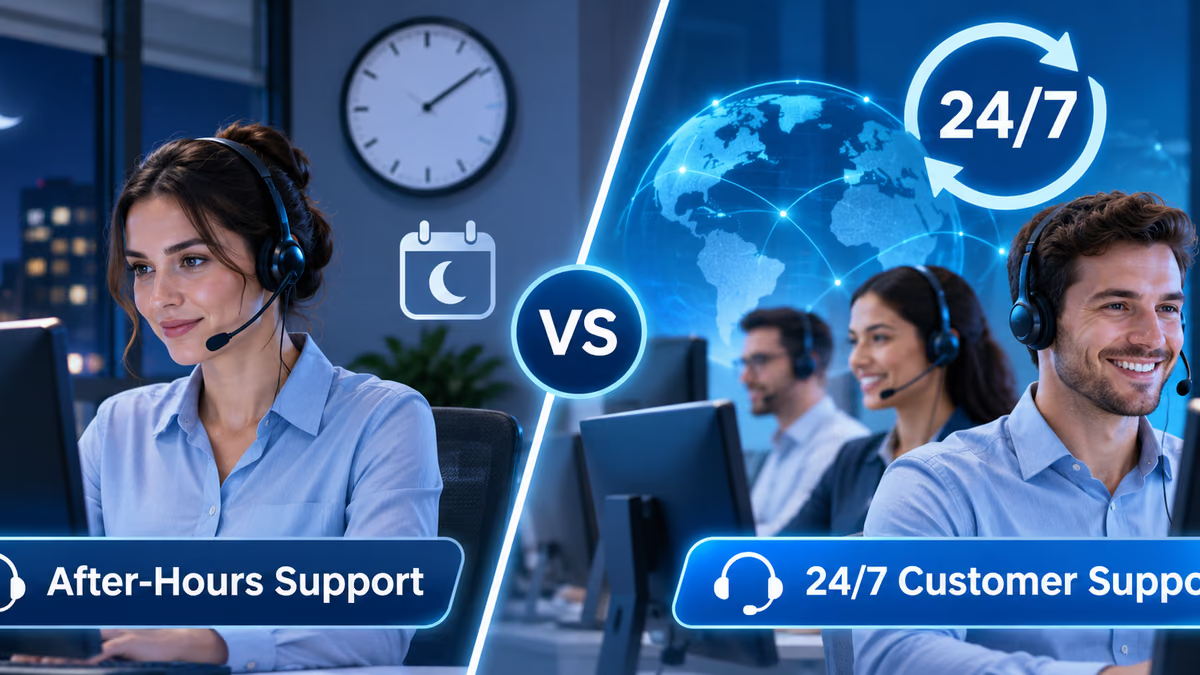
If you are planning to outsource customer support, the two popular options are after-hours vs. 24/7 customer support. Both may sound like similar concepts, but the terms can’t be used interchangeably.
The difference matters for companies that need to cover response times, escalation procedures, and staffing requirements—all within a limited budget.
What are After-Hours vs. 24/7 Customer Support Services
We offer both after-hours and 24/7 customer support, so companies of all sizes and budgets can choose what fits their staffing needs and coverage requirements. Before you choose, let’s understand the key differences between the two.
-
After Hours Support Service
Let’s say your business operates from 9 AM to 5 PM. And while you have an in-house customer support department that can handle your customers’ calls, messages, or tickets during this window, they may not be available past 5 PM.
You may not want your team to be at the office throughout the night, just in case your customers call at an unprecedented time. Now, you may also not want your customers’ calls to go into your voicemail if they arrive after your business closes. An outsourced after-hours support fills this gap.
The exact coverage requirements can vary from business to business. For example, some need support on weekends, some on holidays, some require overnight support, and some may need a combination of these.
31West’s after-hours support helps all your customers beyond your business’ operating hours. Whether they want answers to simple questions, need ticket resolution, or have critical issues that require escalation to the designated teams, we provide all kinds of technical assistance at all hours.
Choose our custom after-hours support service and let your in-house team rest while we make sure your customers are served after your business hours.
-
24/7 Customer Support Service
Imagine having a support extension service that is available, round-the-clock, Monday to Sunday, on holidays, and throughout the year. That is precisely 24/7 support. Your business may shut physically, but you will never be offline.
Suppose you have a software platform that’s used by clients in America, Asia, Australia, and Europe. Clients working hours will be different in each region. While one region may just start work, another could be asleep.
The time differences can be substantial, making it physically impossible for your in-house support team to cater to all time zones. These businesses require dedicated 24/7 support that is always available to assist their customers, no matter the time or day.
To make customer support a seamless experience for both businesses and their customers, we’ve introduced 24/7 support. This enables companies to focus more on business-related tasks, while we handle the most time-consuming yet sensitive aspect of your operations.
After-Hours vs. 24/7 Customer Support: How are they Different?
The most noticeable difference between the two lies in the operating hours. After-hours simply refers to customer support outside your business hours, but may or may not include holidays, weekends, or specific days.
Think of it as outsourcing support for a fixed number of hours after your business closes or only during weekends. 24/7 covers the entire gap by making support available all the time. Here’s a quick table that lists the key differences.
| Factors | After-Hours Support | 24/7 Support |
|---|---|---|
| Meaning | Support services extending beyond business’ operating hours. | Support services available round-the-clock, every day of the year, including weekends and holidays. |
| Coverage | Limited, usually confined to your selected hours or days | Unlimited coverage |
| Best For | Companies with predictable customer support needs | Businesses with unpredictable customer support needs |
| Staffing | Small teams that handle your customer support for your selected time slot | Shift-based system for smoother management throughout the day |
| Cost | Less expensive, as it covers a specific part of the day or a few days | More expensive, as it offers wider coverage |
| Escalation | Emergency technical issues can be re-routed to the on-call employee, while less-serious ones may have to wait till morning or when business opens | Both urgent and less-urgent issues are either resolved immediately or escalated immediately to the appropriate team |
| Time-zone coverage | Ideal for businesses with an audience from specific time zones, requiring coverage on predictable hours | Ideal for businesses with audiences based across the world |
| Customization | Customizable; you can add or remove hours based on your customer support requirements | Requires staffing throughout the week |
After Hours Vs 24/7 Customer Support: How Staffing Hand Handoff Differs?
A common difference between after-hours and 24/7 customer support is what happens behind the scenes.
-
After Hours
The handoff is pretty straightforward. Once your client’s in-house team signs off, your outsourced after-hours support team’s job begins.
If it is a minor, manageable issue that the support team is authorized to resolve, they will resolve it immediately. Complex technical issues, on the other hand, can be escalated. Once the client’s regular team starts work, they can resolve pending issues on the basis of urgency.
The biggest advantage is that the after-hours support team doesnot have to maintain separate records or create new ones for issues they receive during their work hours.
At 31West, for example, we work with clients’ existing CRM software and help desk systems, making all issues easier to view and manage. This creates a seamless workflow between the internal and after-hours team.
-
24/7 Support
Now, the documentation part can get tricky with 24/7 support services. It involves multiple shifts and continuous handoffs.
For example, before ending the shift, employees must leave enough information for the next shift to understand which tickets were raised, which were escalated, which customers called, and what they needed help with.
This is why a 24/7 support team is not just about being available throughout the day, but about having a deep and clear understanding of how SOPs, the ticketing system, escalation, and monitoring work.
In other words, when businesses hire 24/7 support, they need to look beyond the number of agents they’ll be provided. Their training, qualifications, experience, and ability to organize workflows matter just as much.
After Hours Vs 24/7 Customer Support: Which Option is Cheaper?
One of the biggest considerations when it comes to after-hours support service is the cost. Not every company has the budget for outsourcing their support services to a 24/7 support company. At the same time, they may not want to compromise on the extra support hours.
-
After Hours
After-hours support is less expensive than 24/7 support. The reason is clear—you pay for the services used. For example, suppose your business receives 90 customer queries between 9 AM and 5 PM, i.e., during your operational hours, and around 5-10 queries at night.
So, 24/7 support in such cases will be rarely needed. A small after-hours support team that can handle the few customer calls and messages after business hours will do. That’s a financially reasonable deal.
That said, a smaller volume of customer queries during the night doesn’t necessarily mean they are meaningless. The call at night could be from a stranded driver looking for urgent help, or from a client who’s facing a server outage. That’s why the nature of queries matters as much as the volume.
-
24/7 Support
24/7 customer support is costlier because you get continuous staffing. It is useful for companies that do not have predictable hours for customer inquiries.
For example, businesses that provide their services across the globe may have clients from different time zones. Since you get a bigger team working at different hours to handle customers from different regions, its obvious that the service will cost you more.
After Hours Vs 24/7 Customer Support: How Issues are Escalated?
Another important consideration is how an urgent customer query is addressed and escalated. Let us see how after-hours and 24/7 support respond to urgent concerns.
-
After Hours
An outsourced support team should not be confused with the internal team that handles complex technical issues.
They handle Tier 1 concerns, such as simple queries about return policy or businesses’ products or services. Critical issues, such as a hotel guest facing an issue with their reservation or a driver being unable to complete the delivery, require someone from the in-house team.
So, a good after-hours support team separates routine inquiries from critical issues. They also follow a clean escalation process.
-
24/7 Support
24/7 support does the same job, but takes it one step ahead by providing 24/7 availability. They ensure that no customer call or message is missed, irrespective of the time they require assistance.
They act as your business’ first-line support that gathers information, records it in your system, and escalates what is necessary to the top-tier team.
Note that 24/7 support does not mean this outsourced team is authorized to handle critical issues. They also follow the same escalation process as after-hours support.
Industries and Use Cases
Let’s understand the use cases of each.
-
Healthcare
Healthcare companies may benefit from 24/7 support, as customer queries can arise at any time. Queries can be related to appointment schedules, administrative issues, or an emergency consultation with a healthcare professional.
The outsourced support team does not replace the clinical team, but adds an extra layer of communication and ensures coordinated workflows.
-
Logistics
Logistics is another industry that may require ongoing technical support because shipments, tracking, and drivers work overnight. A customer request regarding a delivery, failed delivery, drivers queries regarding routes, and other transportation problems can occur anytime, including after your business closes. Having 24/7 support ensures that emergency inquiries do not go unheard.
-
Technology and IT
Server downtime, password problems, or an application issue can occur at any time. Certain security-related issues, such as a potential breach, cannot wait until the next morning.
However, not every tech or SaaS company requires round-the-clock support. Those running on a small scale or startups can start with custom after-hours support and gradually increase the support hours. As your business expands and your clientele grows, you can switch to 24/7 support.
-
Ecommerce
Ecommerce stores may receive queries about their order delivery status, the store return policy, issues with the product, and application-related queries.
Smaller stores operating within a single time zone can choose after-hours support for overnight or weekend support, while those operating globally or with a high sales volume can get 24/7 support.
-
Finance
Financial companies or banks may also benefit from 24/7 support, because transaction-related issues are time-sensitive. Customers do not just ask about loan applications or how to open a bank account.
Some queries can be about a fraudulent transaction or someone trying to access a customer’s bank account. These issues are time-sensitive and require a clear escalation procedure.
Conclusion
Hiring outsourced customer support is not an all-or-nothing decision. Businesses may first need to compare in-house and outsourced after-hours customer support to decide whether an internal team, an external provider, or a hybrid model is the better operational fit. At 31West, for example, we offer all types of support services, including after-hours support, customized support timing, global business hours, and 24/7 support.
You can choose what works best for your business and customers. We also work with your existing CRM solutions, allowing a smooth transition between internal and outsourced support.
Frequently Asked Questions
What is After-Hours customer support?
After-hours support extends your company's support services beyond your business’s regular operating hours.
What is 24/7 customer support?
24/7 support is available round-the-clock, every day, including weekends and holidays.
Which is cheaper: after-hours or 24/7 customer support?
After-hours is cheaper than 24/7, as it has relatively lower coverage.
When is 24/7 support needed?
This service is particularly for businesses that run globally or have audiences based across different time zones, or for large-scale companies that require broader coverage.
How does after-hours support work?
When a customer raises a query, an after-hours support team either addresses it, creates or updates a ticket, or escalates an issue to higher-tier technical staff.
Does 24/7 resolve complex technical issues?
No, they may handle small issues and escalate the complex ones that they aren’t authorized to resolve.
Does after-hours support include weekends?
Yes, it can be added, depending on business requirements.
Does 24/7 support include national holidays?
Yes, it includes national holidays.
What coverage do you get from after-hours support?
You can customize the coverage based on your needs. You can include weekends, holidays, overnight support, and other days.
Which is better: 24/7 or after-hours?
Which service is better for you depends largely on the nature of your business. Certain time-sensitive businesses may require 24/7 support, as most inquiries require emergency support, while others may rarely get a text or call after business hours.