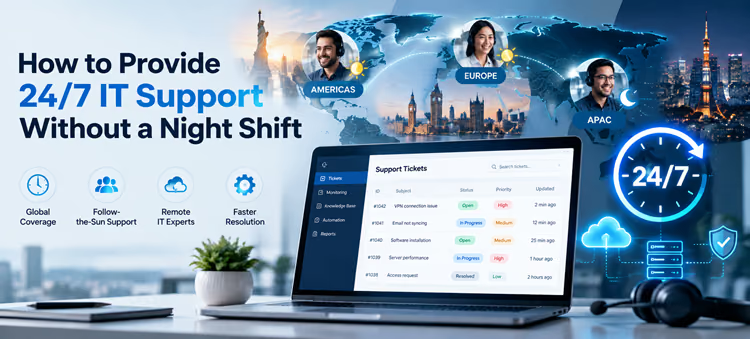


IT emergencies do not wait until your business opens. Crises can happen at any time. When a client reaches out to you with a technical concern, they may want you to resolve it or at least acknowledge it.
Many concerns that MSPs (Managed Service Providers) receive regularly fall into the “priority” categories. This means these issues require a live agent who can address them immediately.
This raises the question: How does an MSP provide reliable after-hours support without burning out their technicians? Not every IT help desk has the resources to build a night shift operation from scratch. However, the nature of the queries they handle requires 24/7 presence.
One practical strategy is to outsource nighttime operations to third-party service providers. Partnering with an IT outsourcing company can help you run your business round-the-clock without the cost of creating the entire IT help desk operation.
In this post, we’ll look at how working with after-hours IT support services can benefit an MSP, and some practical tips for staying open for your clients 24/7 without having a night shift.
After-Hours Support for MSPs: Why Is It Important?
Today, the standard working hours no longer define when an IT system is used. 24/7 support matters for businesses that have employees working in different time zones, customers who make purchases at midnight, or simply a large organization that relies on servers, cloud applications, and uninterrupted networks.
An interruption in the IT system, such as a failed VPN connection, can make it difficult for a remote employee to access the client’s secure connection and use the company’s resources. Likewise, a server downtime can bring a business’s online operations to a halt, making it inaccessible to its customers.
Now, if this client has hired an MSP company, they will expect the service providers to be available when needed, regardless of the time. Certain technical issues can’t wait till the morning. They require immediate attention, escalation, and, depending on the nature of the request, may need to be resolved as soon as possible.
Financial Impact of Downtime
An ITIC study shows that 91% of businesses agreed to losing over $300,000 from just a single hour of downtime. Another 44% of the respondents said that an hour of downtime can cost their business over $1 million.
The impact of even a single incident of downtime can cost your business thousands of dollars. And it’s not just the financial impact; downtime can lead to lost productivity and damaged reputation.
Cybersecurity Challenges
Cybersecurity threats create another challenge for SMEs and MSPs. Research shows that cybersecurity-related incidents can cost the world $23 trillion in 2027. The data is not specific to the companies that work with MSPs, but to all industries combined.
The statistics highlight the need for having a robust response process, preferably a support system that’s available round-the-clock for immediate assistance.
The level of support a business expects from an MSP depends mainly on the service level agreement. If you have agreed to provide after-hours support in writing or verbally, then it’s non-negotiable. Your client relies on your help desk company to manage all IT-related issues when they go offline.
Tips for Providing After-Hours Support Without a Night Shift
Limiting your support service to business hours may seem the most straightforward solution for an MSP that can’t operate throughout the night, on weekends, or holidays.
However, with the growing demand for 24/7 support desk operations, and most MSPs catering to this need, extending your working hours is the only way to stay in the competition.
Here’s how it can be done.
1. Outsource After-Hours Support to a Third-Party Help Desk
The easiest and financially feasible option is to consider a staffing model that provides 24/7 coverage without requiring you to divide your team into shifts or maintain your own overnight customer support operation.
You don’t have to use your internal team for nighttime support desk operations, nor do you have to rotate shifts. Outsource overnight customer support to a third-party help desk company, such as 31 West, and they will handle all customer requests, IT issues, troubleshooting, and ticketing systems on your behalf. If needed, they will escalate the problem to your internal engineers.
The benefit? This saves you the cost and time needed to employ and train new agents to cover night shifts or weekends.
For example, suppose your internal team starts work at 8 AM and signs off at 4 PM. Your outsourced help desk can take over your agreed responsibilities from 4 PM until your team resumes.
Instead of working separately, they become an extension of your service desk operations. This makes managing 24/7 operations smoother, stress-free, and most importantly, affordable.
2. Build a Support Desk Around Your Client’s Requirements
A 24/7 support model isn’t for every MSP. If you have a few local clients with predictable customer requests, most of which are received during business hours and are not urgent, you may not need round-the-clock support.
Another MSP may have a wide clientele, working in different time zones, and expecting technical or complex customer queries at all hours. Such companies may need a full-fledged support desk operation that never sleeps.
Before you hire support services, look at your contractual commitments, clients, and previous ticket volumes and patterns to understand which staffing model is appropriate. Here’s what you can consider.
-
Weekend & After-Hours Coverage:
Your internal team can still handle customer tickets and questions during the day, while the external support desk can start after your business hours. Their service may extend to weekends, nighttime operations, or specific holidays, based on the service level agreement.
-
24/7 Help Desk:
Your external support team can handle your entire help desk operations. They may assign agents for daytime and overnight support, or rotate shifts to ensure comprehensive coverage with proper escalation. This option is suitable for MSPs with a massive client base.
-
Hybrid Support:
This model allows both external and internal MSP teams to work together to provide comprehensive coverage, with shared responsibilities. While the internal team might be assigned more complex, business-specific tickets that require deeper business understanding, the external team can cover basic questions and troubleshooting.
3. Establish Roles of Your Teams Clearly
A major concern that arises when outsourcing your support desk operations to a third-party service provider is whether they can handle all technical concerns as effectively as your internal MSP engineers do.
When working with an outsider, security may be another concern, especially if you work with healthcare, financial, or other sensitive industries that involve confidential data. Your clients trust their customers’ data with you. They may not want outsiders getting access to the sensitive data.
By defining your team’s roles clearly and following the least-privilege access model, you can create a reliable support desk operation that works efficiently and can be trusted. Here’s how you can divide the support roles:
-
First-line Support:
First-line support is for basic employee or end-user issues that have established procedures or can be resolved with simple troubleshooting. For example, suppose an employee has forgotten the password to their account and is unable to reset it. A first-line support agent can verify their identity and help them reset the password.
-
Second-line Support:
This team is for level 2 problems that the first-line agents cannot resolve because of restricted access, limited knowledge of the business or its customers, or due to their permission status. Such concerns can be assigned to level 2 agents, who may have the tools and permission needed to resolve complex technical problems efficiently.
-
Third-line Support:
The third-line support is for internal, highly qualified, trained, and experienced engineers who can fix the most complicated technical problems. Their role may involve working with cloud infrastructure, cybersecurity, networking, and specific business applications. For example, a security concern that poses a threat to the entire organization, its operations, and customers might be immediately escalated to a third-line support agent with the required access levels, business knowledge, and technical expertise.
An MSP can outsource the first-line and second-line support to a third-party help desk while taking accountability for specialist-level issues.
3. Have Clear Escalation Procedures
While outsourcing support desk operations to a third-party can save you time and resources, their availability alone doesn’t mean good support operations. A quality support experience is as important as 24/7 availability.
When drafting a service level agreement, you must clearly mention your expected response time, escalation rules, the types of questions they are authorized to handle, and how they must prioritize issues.
For example, an employee who can’t update the tracking details of a customer order can wait until the morning, but a server outage that affects the entire business operation is a major issue that needs immediate handling.
The agreement must clearly address the first response time and resolution time. Both are different. The first response refers to when an agent responds to the customer’s question or starts resolving it, while the resolution time calculates the total time it takes for an agent to resolve the concern.
You must also clearly define the escalation process. Outsourced IT teams must know which issues they are authorized to resolve vs. which require escalation. They must be able to differentiate between level 1, level 2, and level 3 support.
The goal is to prevent agents from escalating simple, basic issues to the top-tier engineers, as well as attempting to solve highly technical problems that they aren’t supposed to handle.
Final Words
24/7 support has become an essential component of your help desk operations. For MSPs that are supposed to provide round-the-clock availability and weekend coverage, after-hours support doesn’t necessarily mean working extra shifts or building a larger team.
The simplest and most practical way to fulfil your clients’ growing needs is by outsourcing after-hours support to another help desk company. With the right support team, you can extend your operations beyond operating hours, provide quality support, and improve your response time and resolution rate.
Frequently Asked Questions
What does after-hours support mean for your business?
After-hours support refers to help desk support beyond your business’ operating hours.
What does L1, L2, L3, and L4 support mean in IT?
This is an escalation model that classifies each issue into a specific level based on its complexity, urgency, and technicality.
What’s the most suitable staffing model for a small MSP?
If you are just starting or have a small setup, having a dedicated night shift or 24/7 staff for your help desk may be costly. If you receive customer requests after work hours, you can outsource after-hours help desk support to an external team rather than building the entire operation from scratch.
Can a help desk provider handle multiple MSPs simultaneously?
Yes, an external IT help desk company with the staffing to support multiple clients and different business environments can work with multiple MSPs.
Why is a service level agreement important?
It’s important to have a service level agreement if you are hiring third-party services. The document is a written agreement between an MSP and a help desk, stating the external team’s responsibilities, first-time response, resolution rate, and other metrics.
What information does the after-hours support desk need before starting work?
They need client contact details, troubleshooting steps, escalation details, technical documentation, escalation contacts, and access to the necessary accounts and systems.
What does the least-privilege access model mean?
The Principle of Least Privilege refers to providing only the necessary system access to your agents.
What if multiple clients face technical issues at the same time?
You must have an established priority procedure, which helps your agent identify urgent issues. Backup escalation, on-call employees, and specialist engineers are important to ensure smooth issue resolution.
What should you look for in a third-party help desk company before hiring?
An MSP must evaluate the company’s expertise, technical knowledge, availability, staffing arrangements, security practices, reporting, and escalation procedures.
How can you track the performance of your outsourced IT desk?
Response times, resolution rate, client feedback, and service-level compliance are a few metrics you can use to track agents’ performance.