

Did you know 82% of customers want answers to their sales-related questions within 10 minutes? Yet businesses’ internal IT support teams take about 42 hours to respond. Your business might run efficiently on a 9-5 schedule, but your customers can’t.
They may have a simple question about your business at 2 AM, or they may be trying to buy a product from your online store only to get a “payment couldn’t be processed” error. In these situations, they look for your support team. That’s where overnight customer support comes into the picture.
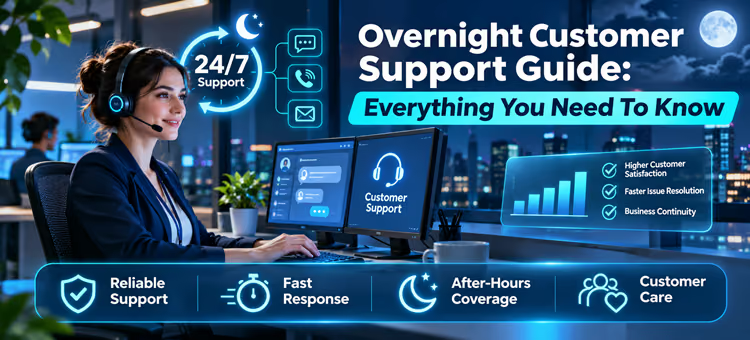
In this guide, we’ve explained the reasons every business, from a startup to a multinational company, requires an overnight customer support system.
What Does an Overnight Customer Support Service Cover?
Overnight support doesn’t necessarily mean all your customers’ concerns will be resolved at night.
You need to clearly define which issues the outsourced team is authorized to resolve, which should be escalated immediately to the on-call employee, and which can wait till your in-office employees sign in.
For further reading, see “everything you must know about outsourcing.”
Although each business may have different requirements from IT support teams, most agents are authorized to:
- Pick customer calls
- Reply to their emails
- Respond to live chats
- Create and update tickets
- Check account information
- Review your customers’ order details
- Answer routine product or service-related questions
- Offer Tier 1 technical support
- Handle appointments or reservations
- Escalate urgent issues
For further reading, see “tier 1 technical support.”
Why Your Customers May Contact You Overnight
Overnight customer hours make sense when you have vendors, customers, employees, or business associates who may require technical support at any hour.
Let’s have a look at the common reasons your customers may contact you overnight.
-
They have Account-related Issues
Imagine this: your customer needs to log into their accounts at midnight, but they can’t. Or, they notice incorrect information in their account details. Or, they are unable to find or access a service they need.
An after-hours IT team can troubleshoot basic issues, check your user’s account information, update the data that they are authorized to, and escalate the issues that seem urgent.
-
They Need an Update
Your customer may have questions about their order status, such as where it has reached, why it hasn’t arrived at the scheduled time, or how long until they can expect their orders delivered. Or, they may have cancellation requests.
An overnight support team may not be able to fulfill all your customers’ concerns, but they can provide available information, such as sharing their order status or connecting them with a delivery agent.
-
They Have a Payment Concern
Your customers won’t always purchase things during your office hours. They may check your website at night, place an order, and complete the payment at night or during weekends.
It’s important to have a dedicated IT support team that can look into their payment or transaction issues and guide them appropriately.
For example, when a customer experiences a declined payment, an unusual transaction alert, or a bill they can’t understand, they may not wait until your office hours start.
-
They are Calling from Another Time Zone
If you have a wider audience base, based in different parts of the world, you must expect calls from different time zones. What you see as overnight support is simply their regular business hours contact time.
Let’s say you run a business from America, providing your products and services to global clientele. An Australian customer asks a question when your American office is closed. So, these questions will be routed to your overnight IT support desk, which will either resolve the issue there and then, update it in the record, or escalate it.
-
They Can’t Access a Service
When a customer experiences a service outage, they may not be patient enough to wait till the morning. They may have questions, like:
- Is the company aware of the service outage
- Are they the only one experiencing the issue, or is it affecting all accounts?
- When can the service be back?
- What can they do to experience uninterrupted service?
An overnight support team can step in, check the information provided by the company, and guide these customers accordingly. The biggest advantage is that your customers won’t be left wondering what the issue is.
If the company’s servers are working fine or there seems to be an issue from the customers’ end, the support team can walk your customer through simple troubleshooting steps, such as checking their connection, restarting the app, or re-checking their login credentials.
-
They have a Security-Related Concern
Security concerns can’t wait. When a customer gets a suspicious email or a notification saying that someone is trying to log into their accounts, or someone has requested a password change, they may want to quickly report it to the customer support team.
Your IT support team can verify the customer’s account details, guide them through the account recovery process, and escalate the matter immediately to the dedicated teams if they suspect a security breach.
What are the Staffing Models Available?
Let’s understand the common staffing models.
-
Dedicated Overnight Team
This team works exclusively at night rather than switching between day and night shifts. Over time, they become familiar with the type of questions asked overnight. It’s a practical staffing model for organizations that expect predictable customer queries at night.
-
Rotating Shifts
It’s another model that allows companies to rotate shifts instead of hiring an IT team as their permanent overnight support service. You can rotate shifts between existing employees and the outsourced IT department, allowing both to work in the daytime and at night.
-
Extended Hours Team
If you don’t receive many customer queries overnight, yet still receive a few important calls now and then, an extended hours team may be the best option. It allows you to extend your customer support service hours for a few extra hours, particularly in the evening and in the early morning.
_For example, if your business hours are 9-5, the extended hours team can work from 6-11 to provide extra coverage without charging you for the capacity that’s not used.
-
Hybrid Model
This staffing model combines your overnight support team, on-call specialists, and internal teams, providing much more extensive coverage than the above options.
For example, your outsourced team can handle basic customer queries, while the specialized technical team works as the on-call specialists for complex technical issues.
What a Structured Shift Handoff Looks Like
A crucial element of overnight customer support is a seamless transition between outsourced and internal support teams.
Simply put, when your in-house employees arrive, they must not have to go through multiple documents or call your outsourced teams to figure out what happened during the night.
Each call, text, and ticket must be properly documented and organized in a way that the internal team can not only access but understand everything easily. When the morning support team signs in, they must know:
- What happened?
- What was already done?
- What should happen next?
- Who is responsible for the next step?
- How urgent is the issue?
Essentially, a proper handoff must include high-priority tickets, unresolved customer issues from the night, active escalations, promised callbacks, and pending approvals.
Why Structured Escalation and On-Call Coordination is Important
Escalation refers to passing a customer’s inquiry to a higher authority or the organization’s internal team.
A clear, structured escalation framework is crucial to ensure that critical issues are addressed promptly while less serious ones are either resolved by the agents themselves or escalated to the designated teams with proper priority tags.
Now, there’s a difference between a critical issue and a technically complex one. Sometimes, the issue that seems technically complicated may not be serious or require urgent handling, while the simpler matter can cause serious loss to the client.
Here’s how escalation frameworks categorize customer issues:
-
Critical Issues:
Priority 1 can present critical issues, which may directly impact a business’ function, reputation, or safety. These require immediate escalation and, sometimes, an on-call support team for prompt assistance.
-
High Priority:
These issues may impact a business but do not meet the criteria to be classified as critical. The overnight support team can help with basic troubleshooting while following the escalation framework.
-
Standard:
These are less serious issues, usually the ones affecting individual customers. An overnight support agent can attempt to resolve them or raise/update a ticket.
-
Low:
These are the least serious issues. For example, a customer raising enquiries about a product or asking for specific information about a business’ operations isn’t considered emergency.
An important concept here is understanding when escalation is needed and who the issue should be escalated to.
If an overnight agent starts connecting all issues, even the less significant ones, to the on-call specialist, the system can become inefficient. This is why the escalation roles and criteria must be clearly defined.
How Overnight Agents are Given Access to Technology?
For an overnight agent to answer or resolve queries, they require permission to access the relevant systems. This doesn’t mean they require the same authority and access as your internal team.
However, they must not try to open a system at 3 AM to work on a customer issue, only to realize they aren’t authorized to access the particular system, or that they have a pending approval from someone who isn’t available at that hour.
Companies must test the system before launching an overnight support service.
Overnight KPIs: How to Know if Your Overnight Support Team is Working Efficiently?
KPIs are the measurable metrics that help organizations understand how well their dedicated overnight support team is functioning and where they may need improvement. A few critical metrics include:
-
Response Time:
This shows the average response time of an agent after a customer calls, sends an email, or raises a ticket.
-
Abandonment Rate:
It tells the number of customers who hang up the call before connecting to the agent. A higher abandonment rate means you may not have adequate staff to cater to the increasing overnight support demand.
-
First Contact Resolution:
This shows how successfully agents can resolve common customer problems within the first interaction.
-
Escalation Rate:
An escalation rate tells how often an agent escalates the issue to another team member or an IT specialist.
-
SLA Compliance:
This metric tells whether the agent manages to fulfill the response and resolution time promised to customers.
-
Customer Satisfaction:
A customer satisfaction rate shows how satisfied customers are with the overnight support. They may be asked to leave a rating and feedback that can help assess agents’ service.
Final Words
When your employees sign off for the day, 31 West’s support team continues to address your customers’ concerns, ensuring that no question is left unheard and no customer has to wait till the morning to speak with an agent.
Overnight customer support isn’t just about answering your customers’ calls. It involves clear responsibilities, a proper escalation route, clean documentation, secure system access, and proper handoffs.
Frequently Asked Questions
What is overnight support?
Overnight customer support, as the name suggests, is an outsourced IT support service that provides coverage outside your company’s operating hours.
What IT support does 31West Provide?
We provide dedicated 24/7 customer support for organizations looking for broader coverage, as well as customized support options that you can set according to your coverage needs.
Does an overnight support team replace your in-house IT team?
No, the outsourced overnight customer support team cannot replace the in-house IT department. They cannot process requests or resolve issues beyond their authority.
Why overnight support team and your in-house IT Team have different levels of authority?
This difference is really important when there’s a health-related query, sensitive customer information, and confidential data involved. This is why clear explanations of the agents’ duties beyond your business’ working hours are crucial.
When should you hire overnight support?
If your business constantly receives customer queries at night, it may be worth considering a dedicated overnight support staff.
Is overnight customer support costlier than 24/7 support?
No, it’s more affordable than 24/7 support because it may or may not cover weekends and holidays.
How to choose the best staffing model?
The best staffing model for your business depends on a few factors, such as how many calls you expect overnight, how urgent most calls are, where your customers are located, and what the consequences can be when a customer’s concern remains unresolved till the morning.
How are agents given system permission?
Usually, the least-privilege model is followed, where an agent is allowed access to only systems they need to resolve customer issues.
What should an overnight customer support operation involve?
It must have clear responsibilities, a proper escalation route, clean documentation, secure system access, and proper handoffs.
Do all businesses require overnight support?
No, companies that expect calls, texts, or emails from customers at night need an extended-hour support.